AI for Automating RFP compliance matrices.
You have reached the final deadline for your latest Request for Proposal (RFP). The submissions are in, but now you face 20 different vendor proposals, totaling hundreds of pages of dense technical and legal jargon.
The initial relief of receiving bids often turns into the dread of the "messy middle." This phase usually requires weeks of manual reviews to identify which vendor is actually compliant with your requirements.
Procurement leaders often ask what AI RFP software can accelerate this process. Manual creation of compliance matrices is a major bottleneck that delays critical projects and leads to inconsistent scoring across evaluation teams.
TL;DR - Key Takeaways
- Compliance matrices are essential for turning documentation chaos into defensible decisions, but manual creation is often slow and prone to human error.
- Specialized AI analysis tools like BidHawk AI automatically analyze, score, and rank multiple proposals against your specific requirements in less than 5 minutes.
- AI analysis automation helps teams avoid the "subjectivity trap" where different human reviewers interpret the same vendor response inconsistently during the evaluation process.
- Companies need specialized RFP Tools that act as a Digital Subject Matter Expert to identify high-risk areas like non-compliance or vague marketing language.
- Analysis-first tools like BidHawk AI remove the implementation gap by allowing teams to get results on Day 1 without building massive content libraries and navigating third party environments and interfaces to get the results they need.
The Challenge of Manual Compliance Matrices
Many teams rely on spreadsheets for comparisons, but manually typing proposal data into them is slow. This creates a "data prison" where context is lost and version control becomes a major nightmare.
Manual reviews also suffer from reviewer fatigue. A proposal read on Friday rarely gets the same attention as one read on Tuesday morning, leading to inconsistent scoring and potential bias.
Generic AI tools often fail when tasked with the high-stakes, structured analysis required in procurement. They struggle to hold the context of multiple large documents simultaneously for side-by-side comparative analysis.
Additionally, generic templates or boilerplate approaches for evaluation are rarely useful when specific criteria must be met. Teams often struggle to align real-world needs against generic approaches because specific RFP requirements must be addressed.
The volume of information can be overwhelming when managing 10 to 30 proposals per RFP. This leads to missed requirements simply because the human brain struggles to maintain attention across technical text. We have all been there, strong detailed reviews that eventually turn in to skimming proposal content (typically around the 10th proposal in review).
How AI RFP Software Can Help
The fastest way to cut through this noise is to employ a specialized AI tool. These tools focus on the analysis layer, allowing users to drag-and-drop requirements and proposals documents to obtain immediate insights.
Modern AI RFP software uses advanced algorithms to perform deep comparative analysis. This is beyond simple keyword matching, they are focused on understanding the criteria/proposal context and assess the degree of alignment with your stated requirements. Not all tools are created equally.
Instead of requiring manual data entry into a special environment, these tools automatically review, analyze, and rank proposal submissions. They apply consistent (and adaptive) evaluation logic to every document, helping buyers identify the best candidates without bias.
A modern AI RFP Tool can extract all requirements from the solicitation package and adapt to the scenario. This ensures that no critical detail is overlooked when you are building your final evaluation reports and justifications.
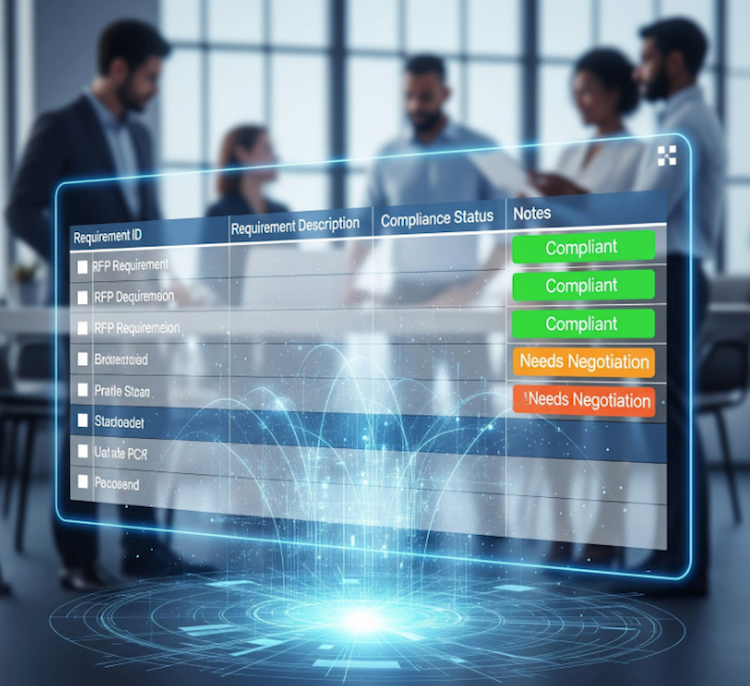
BidHawk AI was built around these fundamental needs. It helps teams accelerate their reviews by automatically tagging proposal items as "Compliant," "Needs Negotiation," or "Subjective.” BidHawk AI reports can help leadership and review teams focus 100% of their energy on high-risk areas that require strategic human judgment - supporting the process not replacing it.
BidHawk AI to generate Compliance Matrices
BidHawk AI is a specialized AI analysis tool designed to bridge the "analysis gap". It functions as a lightweight utility that delivers professional and actionable results typically in less than 5 minutes.
BidHawk AI simplifies the comparison process with an intuitive drag-and-drop user experience. You can upload the RFP criteria and all vendor proposals simultaneously to begin an immediate document-level comparative analysis.
The side-by-side proposal comparison view is a standout feature of BidHawk AI as an RFP tool. It allows you to quickly compare multiple vendors across specific criteria, compliance levels, and objective scoring metrics.
BidHawk AI categorizes findings into four actionable buckets: Compliant, Needs Negotiation, Subjective, and Non-Compliant. This granularity explicitly flags where a vendor used "marketing fluff" instead of providing hard facts. The "marketing fluff" is often the biggest distraction for review teams and leadership; they just want to make an informed decision quickly - not navigate vendor slang or other features options they did not ask for.
Recognizing that final decisions happen in spreadsheets, BidHawk AI does not trap your analysis data. Your analysis results are exportable as PDF executive summaries and Excel files to immediately enable team collaboration on the data.
These portable PDF and Excel reports can be loaded into your collaboration platform of choice, such as Google Workspace or Office 365 - where the real work is done and final decisions are made. This core philosophy ensures all stakeholders can easily obtain and access the data they need without paying for extra software seats or licenses on a bespoke RFP platform.
Example Use Cases
Buyer Side - Shortlisting 25 Vendor Proposals
A purchasing director receives 25 complex vendor proposals and needs to identify the top candidates quickly. Manually reading and scoring these in a spreadsheet would typically take the team 3 to 4 weeks.
Using BidHawk AI, the director uploads the RFP and all proposals to get a ranked list. Within minutes, the system identifies the top compliant submissions, reducing the initial screening and time to award time by approximately 60%. The purchasing director can quickly identify the top 5 vendors to engage and focus the review team on those engagements. BidHawk AI also provides the justifications to support these engagement, or non-engagement, decisions by providing executive summaries and the details to support in PDF and Excel. These justifications are also extremely useful for supporting vendor response write ups for "why."
Vendor Side - Pre-Submission Compliance "Head-Check"
A business development team rushes to meet a deadline and pastes "boilerplate" answers from their library. Standard templates are the death of a proposal when they don’t really address the customer requirements. Missing a specific compliance standard requirement in the RFP or an addendum which could easily lead to disqualification.
Before hitting send, the team uses BidHawk AI to run a final quality check. The tool flags a missing requirement as "Non-Compliant," providing the justification and some suggestions on the needed correction - enabling the team to fix the gap before submission.
Frequently Asked Questions (FAQ)
Does AI replace the need for human reviewers?
No, specialized tools are designed to support your processes, not replace human strategic judgment. They handle the heavy lifting of ranking and compliance checking so experts can focus on strategy. Remember, they are tools to support the process - not replacements!
Is this faster than using a manual spreadsheet?
Yes, manual data entry into spreadsheets is prone to error and incredibly slow. Specialized AI provides professional analysis results typically in under 5 minutes, eliminating the administrative burden of manual comparison.
Do I need a content library to analyze proposals?
No, BidHawk AI utilizes a "Day 1" results approach that analyzes documents you upload in real-time. You do not need to train the system or build a library in another system or re-enter data before you can analyze and obtain the needed insights.
How can I trust the AI scoring results?
BidHawk AI provides cited references to the source documents for every finding, creating an auditable record. This transparency allows human reviewers to verify the AI's logic rather than blindly accepting a score. (always confirm what AI suggests!)
Actionable Takeaways
If you want to reduce your proposal review time from weeks to days, consider these steps:
- Stop Manual Entry: Do not waste time manually typing proposal data into Excel. Use an AI analysis tool to automate the extraction and scoring to feed your spreadsheets faster.
- Focus on Exceptions: Use automated compliance tags from BidHawk AI to focus your team's attention on items marked as "Subjective" or "Needs Negotiation". This ensures your experts and leadership spend their time on high-risk areas.
- Use What You Have: Stick to your in-house collaboration tools for storage and communication. Layer a specialized AI tool on top to handle the heavy lifting of the initial analysis.
- Start Today: Because there is no complex setup required, you can run a pilot on a current RFP immediately. This allows you to see the speed and quality difference for yourself.
By leveraging AI analysis tools, you can transform a weeks-long administrative burden into a strategic decision process. This approach ensures your procurement and proposal decisions are smarter, faster, and more reliable.