The Coming SaaS ApocalypseThe "SaaS Apocalypse" and Hidden Taxes
For years, the modern enterprise has been buried under an avalanche of software subscriptions. This "SaaS sprawl" - a portfolio of expensive, siloed and often incomplete applications offered as a central solution for every conceivable task - creates more friction than it removes. The average company conservatively juggles over 20 different SaaS tools, each with its own per-user license fee, data silo, integration, maintenance and sustainment overheads. This model, once the symbol of modern digital transformation, is now a source of significant cost, dependency (vendor lock), duplicative complexity, and elevated security risks.
Traditional SaaS: Hidden Taxes
The conventional SaaS model, especially for complex processes like RFP and vendor management, imposes significant hidden costs that go far beyond the subscription fee. In essence, adopting a SaaS platform means you are renting a vendor's workflow which comes with inherent limitations and dependencies.
- The Collaboration Tax: The economic friction of a base platform + seat-based pricing is a major barrier to efficiency. With prices ranging from $25 to over $500 per user per month, the cost of providing access to every necessary stakeholder becomes prohibitive. A winning proposal often requires input from infrequent but critical contributors like subject matter experts (SMEs). The per-user model forces a difficult choice: either pay for expensive licenses that sit unused most of the time or exclude key experts, reverting to inefficient email chains (or a suite of other tools to try to close those gaps).
- The Content Treadmill: Legacy platforms often require companies to create and maintain a duplicative content library - a static "source of truth" separate from where information is originally created. Estimates suggest these platforms require 200 to 250 hours of annual maintenance just to keep content current. This "content rot" creates a crisis of trust, as teams can never be sure if the information they are using is accurate.
- The Integration and Alignment Debt: There is an often-overlooked overhead cost related to aligning and overcoming platform limitations to implement the features and workflows you actually need.
- New Technical Debt: As legacy platforms rush to "bolt on" AI features, they effectively increase integration complexity. This adds layers of interfaces within an already technically complicated and expensive administrative process.
- The "Alignment" Speedbump: The movement of data between systems and capabilities is not trivial. Reality hits hard when teams face the "boring IT stuff" of data structures, types, and proprietary interfaces.
- Sustainment Overheads: Companies are forced to incur "expensive technical sustainment overheads" just to understand, align, and leverage platform-specific tooling. Instead of solving business problems, IT teams spend their time managing the "care and feeding" of the platform itself. This creates a new form of technical debt: the cost of fighting the platform's rigid framework to make it work with modern AI capabilities - or just keeping content in sync when changes are occurring in different platforms, tools, systems.
The Sovereignty Surrender and Security Risks
Perhaps most critically, uploading proprietary data to a third-party SaaS platform is an act of surrendering control. "Trust me bro" service agreements are no longer good enough when handing over sensitive company information.
- The "Customer as Product" Risk: There is increasing awareness that your participation as a "customer" often means you are also the "product." Companies must read Terms and Conditions (T&Cs) closely to see if their sensitive data is being used to train the vendor's own AI models.
- The Accountability Gap: Reliance on external proprietary platforms creates genuine intellectual property and financial risks. Often, only "strongly worded letters" govern accountability for the exchange and use of critical information. In an era of strict data privacy regulations, this loss of data sovereignty - where trust is not absolute or guaranteed - is driving a strong trend toward self-hosting and keeping sensitive information behind the company firewall.
The Market Shift: The Platform Wars
A seismic shift is underway, driven by a powerful convergence of practical business processes enabled by Artificial Intelligence (AI). The "Platform Wars" have evolved into a complex battlefield:
- Purpose-built Platforms (e.g., CRM, RFP) are entering a “life or death” struggle to preserve their established customer beachheads. High efforts to align to a platform limitations have raised big questions about “should we just build what we need” vs “buying” something that is not really doing “what we need”?
- Enterprise Platforms (e.g., Microsoft 365, Google) are trying to layer in new AI capabilities without breaking the familiar experiences customers rely on. Specifically, focusing on enabling customers to build directly on their platforms (keeping the process closer to the data) vs integrating with external platforms (requiring the sharing or moving of data off the platform).
- AI-Native Platforms (e.g., OpenAI, Anthropic) are attempting to build new experiences where customers bring their data and build what they actually need, effectively bypassing legacy software.
The "Spinner Bait" Trap
Both Enterprise and AI-native platforms are betting heavily on the inclusion of visual and natural language models. They are betting that a seamless user experience (UX) will be the irresistible "spinner bait" to attract customers. Enterprise platforms are rushing to market new "AI-enabled" features, often by integrating third-party AI-native platforms as back-end services to keep customers engaged. Conversely, AI-native platforms view their capabilities as the new experience, attempting to attract customers away from legacy suites entirely.
The Economic Inversion
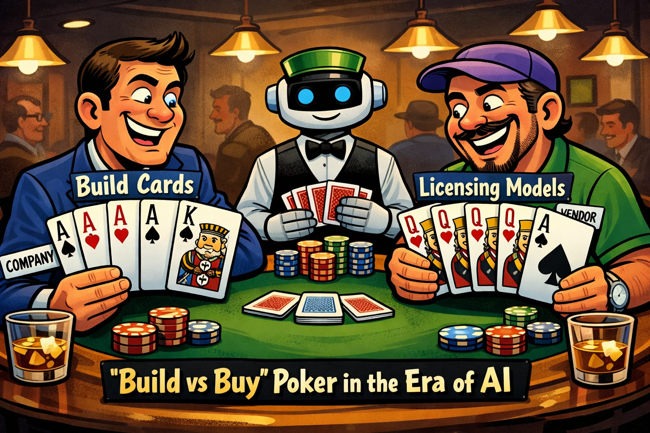
This competition has triggered a realization: "Build" is now cheaper than "Buy". The practice of "Vibe coding" (AI-assisted development) has reduced the labor cost of implementing internal tools by up to 90%, making "build" a viable alternative to "buy.” Companies are already calculating their switching costs and are very tolerant to imperfect results after learning the hard way what "Vendor Lock" feels like for imperfect purchases and unwanted overheads.
The Solution: The New "Trinity" Operating Model
This landscape is being disrupted by the convergence of three forces that form a new operating model: agentic AI, "vibe coding," and Small Language Models (SLMs).
1. The Body: "Vibe Coding" (The Factory)
"Vibe coding" is an AI-assisted development approach where users describe what they want in natural language, and AI generates the necessary codebase. It enables bespoke solutions to be built on top of existing platforms like Google Workspace. It effectively turns "build" into a verb, acknowledging that AI is now a significant component within the business equation.
In reality, purely “vibe coding” approaches are NOT production - good for quick prototypes or even a MVP. “Vibe coding” as a philosophy should be used to write good specifications before building or deploying anything. Good specifications and requirements dramatically increase the likelihood of good results with AI. Always document the design, intent, behaviors needed - they establish guardrails for AI to follow. These should include a prescriptive technical stack, security, and interface guidelines to better assure a useful result. Basically a set of documents that define an independent or reusable “skill” for implementation. While “vibe coding” is good for magical dopamine hits - the results need to be properly scoped for actual deployment and use.
Caution should be taken regarding when and where to apply “vibe coding” - it has its place, but maybe not for every place in the organization. Best results when the features or workflows being built are isolated and in control - this means use “vibe coding” to iterate faster and support the rapid development of a “thing” - a “thing” that is version deployed and managed effectively within your various feature and workflow deployment configurations. Managed, quality, and controlled releases are KEY!
2. The Mind: Small Language Models (SLMs)
While Large Language Models (LLMs) are powerful generalists, Small Language Models (SLMs) are emerging as the workhorses of enterprise AI.
- Privacy & Security: Unlike cloud-only LLMs, SLMs can be deployed on-device or self-hosted behind a firewall, ensuring data process sovereignty.
- Specialization: They are deep, domain-specific specialists rather than broad polymaths.
- Cost: They are cheaper to train and run, making them relevant to the business calculus.
3. The Nervous System: Agentic Architecture
Agentic architecture moves beyond simple tool execution toward a flexible orchestration layer. Instead of just running a predefined tool, an Agentic "Skill" prepares the AI to handle a category of problems by loading context and policies. This allows the system to reason through a process - such as checking if an invoice over $10k requires VP approval - and orchestrate the workflow as a cohesive system.
The Operational Reality: Risks, Configuration, and Change Management
While "Vibe coding" and Agentic AI offer immense potential, they introduce significant operational challenges. The "boring IT stuff" - specifically configuration and change management - moves front and center.
The Danger of "Probabilistic" Configuration
"Vibe coding" is effectively a "contextual popularity contest" with a bit of reasoning mixed in. Because AI is probabilistic (based on likelihoods) rather than deterministic (based on fixed rules), vague requirements guarantee problems.
- AI Slop: Without strict guidance, generated results can become "AI slop" - code that provides limited functionality, unintended side effects, or is simply unmanageable.
- Non-Modular Results: Domain-specific models often defer to the most commonly used architectures they were trained on, which may not be the most current, secure, or modular for your specific environment.
The Trap of "Costly Iterations" and Drift
A major configuration risk in Vibe coding is "drift." Most efforts start with high-level objectives, followed by trial-and-error refinement.
- Interpretive Drift: Seemingly insignificant questions or corrections can be interpreted by the AI as "intent." This moves the AI's attention, significantly changing the trajectory of the result in ways the user did not want.
- Recovery Challenges: When unintended changes occur, recovering to a previous working state is almost impossible within the flow of conversation unless you are proactively taking snapshots. Without rigorous version control, you may find yourself in endless, expensive circular arguments with the AI.
Governance: The "Boring IT Questions"
Before engaging in any AI implementation, companies must answer critical governance questions to avoid operational failure:
- Change Management: How do you recover when the AI model changes or drifts, and results that were acceptable yesterday are unacceptable today?
- Verification: How can you verify and measure the impacts of AI decisions?
- Quarantine Capabilities: There is a new expectation for the ability to instantly quarantine incorrect processes and the data generated by them, followed by the rapid deployment of disposable fixes.
The Fix: Specification-Driven Development
Ambiguity is the enemy. Success requires specification-driven development. All "Vibe coders" eventually realize that documenting objectives and workflows up-front yields better results in a fraction of the time. New visual tools are emerging to help users describe the introspection and transformation of data securely, reducing the randomness of the AI mix.
Practical Application & Conclusion
These technologies are not theoretical; they are being applied today to replace outdated SaaS workflows.
Real-World Use Cases
- The RFP Process: Instead of buying a seat-limited RFP platform where content rots, companies can use AI-native tools that connect directly to Google Drive or SharePoint. The tool's AI agents read live documents and generate trusted answers with direct citations. The result: A process that once took 25 hours now takes 6, with zero additional license fees for collaborators.
- Digital Assistants: An SLM fine-tuned on an HR handbook can serve as an "HR Assistant Bot," while one fine-tuned on proprietary code can act as an expert assistant for software engineers.
Strategic Trends
- Economics have Flipped: Building custom tools is now often cheaper than off-the-shelf subscriptions.
- Reclaiming Sovereignty: Self-hosting SLMs shifts companies from renting rigid processes to owning flexible, proprietary digital assets behind their own firewalls.
- The Productivity Suite as OS: Paying a premium for AI capabilities in a niche SaaS product is becoming unjustifiable when Google Workspace and Microsoft 365 already bundle powerful AI into core plans.
Summary
The era of the monolithic, all-in-one SaaS platform is drawing to a close. The future belongs to a "composable" model, where intelligent AI agents orchestrate outcomes using specialized services and internal data. However, this future requires a disciplined approach to configuration and security. It is not enough to just "vibe"; companies must manage their "brains" with the same rigor they apply to their networks. The technologies to enable this transformation are here. The only question left is: which seat licenses will you eliminate first to fund the creation of your own intelligent assets?
Related Articles
BidHawk AI: Alternatives to Overpriced RFP Software
BidHawk AI: RFP Platform TCO - Analyze & Save
Why analysis-first is better than traditional RFP suites?
BidHawk AI: Improve Proposal Alignment and Win Rates
AI-Enabled Proposal Writing/Reviewing Platforms
BidHawk AI: Fast RFP Analysis in Under 5 Minutes
BidHawk AI: RFP Platform TCO - Analyze & Save
Why analysis-first is better than traditional RFP suites?
BidHawk AI: Improve Proposal Alignment and Win Rates
AI-Enabled Proposal Writing/Reviewing Platforms
BidHawk AI: Fast RFP Analysis in Under 5 Minutes