30 posts tagged with "Assessments"

View All Tags

Vendors Are Asking Which AIs Are Evaluating Their Proposals

· 8 min read

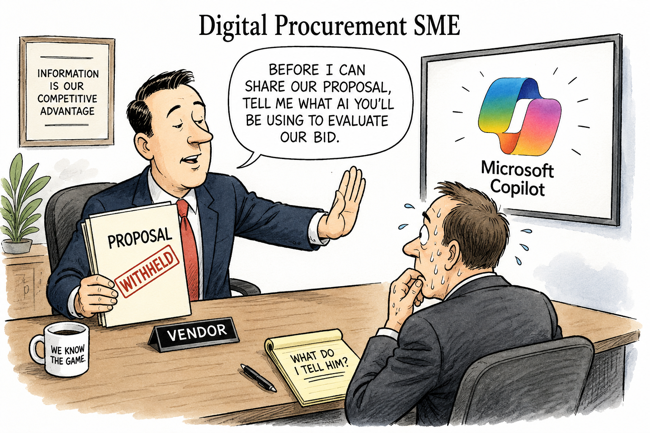
Vendor asking a customer which AI tool is being used to evaluate their proposal

Which AIs Are Evaluating Our Proposals?!

An interesting trend is emerging in procurement today. Vendors are starting to directly ask customers exactly how their proposals are being evaluated internally, specifically regarding the artificial intelligence tools involved.

Historically, vendors have received very limited feedback or insights regarding the internal customer review process. They know artificial intelligence is being used more frequently today, introducing significant risk and anxiety.

Customers might trust generic models too much, deferring judgment inconsistently rather than having a Subject Matter Expert review the material manually. This creates a fascinating and complex development for procurement.

Vendors asking customers about how their proposals will be evaluated is undeniably a risky move. Customers may view the inquiring vendor as positioning for a future challenge or protest.

TL;DR / Key Takeaways

  • Transparency is Demanded: Vendors are increasingly questioning evaluations and want to understand the details of the process, particularly regarding the usage of modern analysis solutions to score and rank submissions.
  • Generic Models Introduce Risk: Different conversational platforms have dramatically different contextual capabilities and can produce drastically different results based on highly subjective human prompts and interactions during the review.
  • Inquiries Create Unwanted Friction: Customers may view the inquiring vendor as an adversary positioning for a future challenge if they do not win the bid, creating unnecessary friction in relationships.
  • Transparency Mitigates Threats: Promoting non-biased analysis helps build confidence in the fairness and consistency of the overall evaluation process for all participating parties, ensuring a smoother procurement lifecycle.
  • Focus on Pure Compliance: AI analysis tools such as BidHawk AI focus purely on strict compliance verification, helping to level-set review teams on common gaps and risks seamlessly and efficiently.

The Elephant in the Room: Escaping the RFP Platform Content Treadmill

· 5 min read

Cartoon Elephant running on a Tredmill looking at a monitor of modern RFP platform

Escaping the RFP Platform "Content Treadmill"

TL;DR

  • The Content Treadmill is Dead: Traditional RFP platforms demand hundreds of hours of annual maintenance to keep content libraries current. Agentic AI platforms eliminate this by organizing and contextualizing existing content automatically.
  • Adaptive Evaluation, Not Generic Templates: BidHawk AI does not use the exact same evaluation criteria for every document; instead, it extracts and adapts to the specific requirements of your unique RFI, RFP, or SOW.
  • Consistent Execution: Once aligned with your specific criteria document, the AI consistently evaluates all vendor proposals against that unique baseline to score, rank, and classify them.
  • Traceable Justifications: The tool explicitly tags items as Compliant, Needs Negotiation, Subjective, or Non-Compliant, providing detailed, cited supporting evidence for every classification to advise your decisions.

Cost Attracts, but Schedule and Performance are MORE important.

· 6 min read

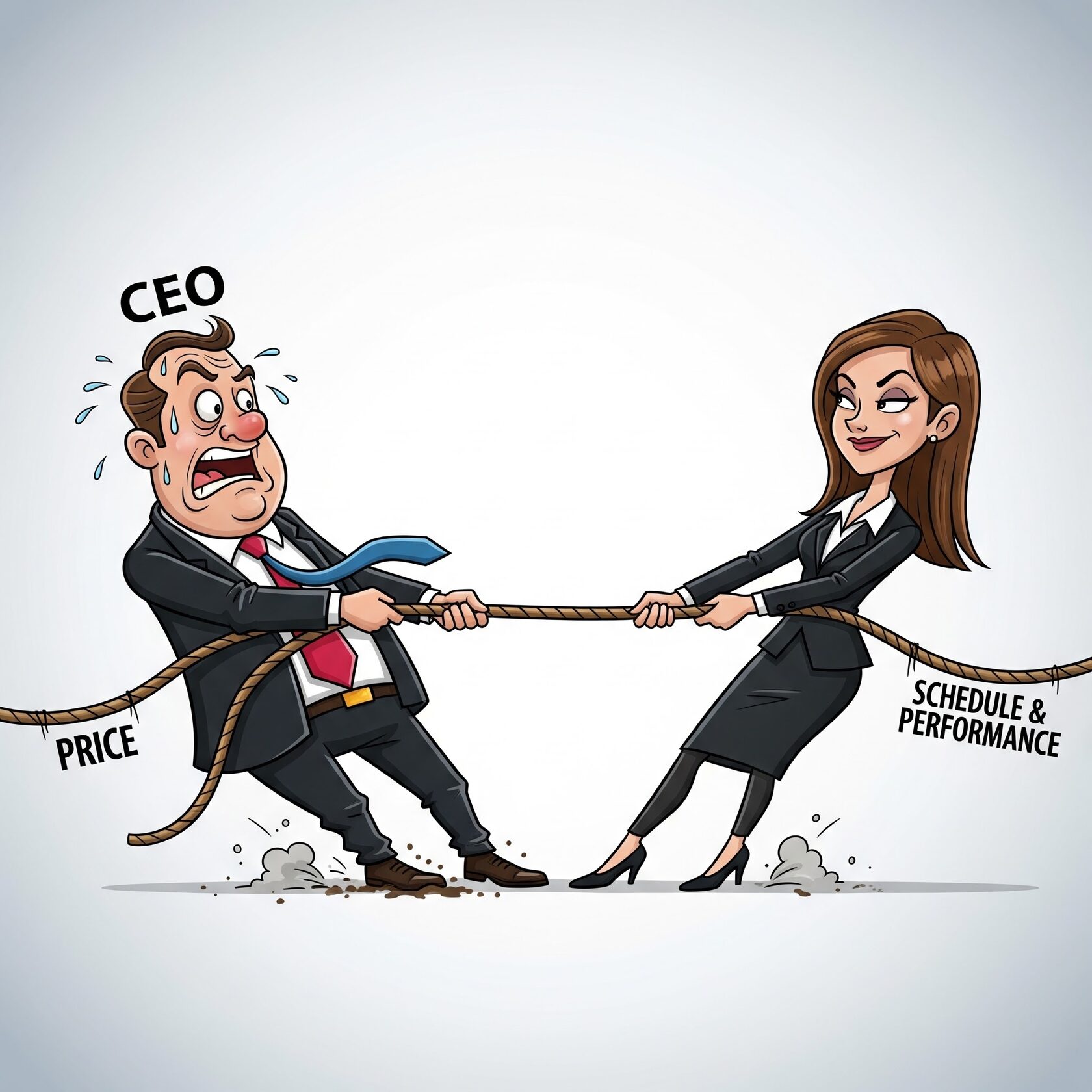
Cartoon of a boss and procurement manager in a tug of war over cost, schedule, and performance.

Introduction

In the high stakes world of procurement, the temptation to over promise is a constant threat. Companies often get blinded by the allure of attractive costs, leaving the reality of schedule and performance as an afterthought.

Cost, Schedule, and Performance are strongly related elements that dictate the success or failure of any engagement. Cost acts as the practical attractor, but schedule represents the undeniable reality of execution.

Ultimately, performance confirms both cost and schedule through actual execution and deliverables. When review teams fail to evaluate schedules with proper skepticism, the risks of project failure increase significantly.

TL;DR

  • Cost, Schedule, and Performance must be consistently evaluated together by procurement teams to successfully avoid over promising and ultimately failing to deliver on critical project expectations.
  • While cost often serves as the initial attractor for leadership, the proposed schedule dictates the realistic and necessary sequence of events required for overall project success.
  • Performance confirms whether the proposed cost and schedule can actually yield the expected deliverables, requiring teams to scrutinize vendor claims with a high degree of skepticism.
  • Evaluating complex proposals demands objective data to uncover hidden risks, highlight compliance gaps, and expose subjective marketing claims that often obscure the true realities of execution.
  • AI analysis tools like BidHawk AI can help structure complex vendor data into clear executive summaries, accelerating review cycles and grounding strategic decisions in factual evidence.

Should companies build or buy an RFP Platform?

· 11 min read

Cartoon of a man beneath a scale showing build vs buy

Buying vs. Building an RFP Platform: The Definitive Choice for Smarter Evaluations

The critical question for any organization navigating the complexities of procurement and proposal management isn't if they need an advanced solution, but how to acquire the most effective one. Companies face an urgent imperative to streamline their RFP, RFQ, RFI, and RFS processes, moving beyond manual drudgery and inconsistent evaluations. The definitive path to unparalleled efficiency and defensible decisions is clear: procuring a purpose-built, AI-powered platform.

How Do I Compare Multiple Vendor Proposals with AI?

· 8 min read

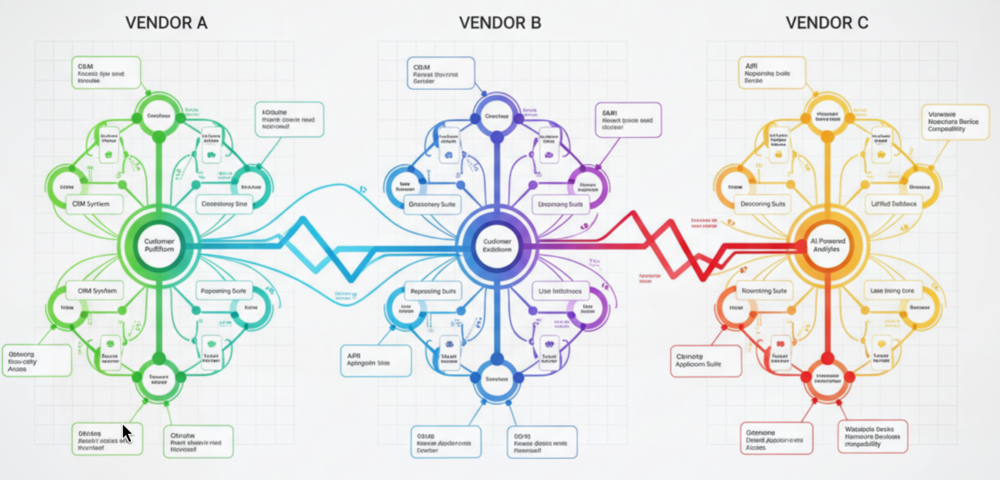
AI vendor comparison maps that look like brains with annotations

Introduction

You have finally reached the deadline for your Request for Proposal (RFP). You spent weeks herding internal cats to get the requirements right, you fought for the budget, and you finally hit send. The submissions are in, and for a brief moment, you feel relief. Then, you open your inbox and stare at the reality: 20 different vendor proposals, all formatted differently, totaling hundreds of pages of dense technical and legal jargon.

The initial relief of receiving bids instantly curdles into the dread of the "messy middle": the weeks of manual reviews required to identify the best options. This is where the real pain begins. You are facing 20 to 80 hours of what industry experts call "spreadsheet archaeology" - digging through PDFs to find answers, manually typing them into Excel, and trying to remember if Vendor A’s security protocol was actually compliant or just sounded nice.

The question every procurement leader and business development manager asks is: "How do I compare multiple vendor proposals with AI?" Traditionally, the answer was either "hire more people" or "buy expensive software" that requires months of implementation. However, a new generation of specialized AI analysis tools is changing this dynamic.

TL;DR: Key Takeaways

  • Analysis Over Administration: The goal is not just to read proposals but to score, rank, and identify gaps to inform critical decisions quickly.
  • The "Friday Afternoon" Effect: Manual reviews suffer from reviewer fatigue; a proposal read on Friday afternoon rarely gets the same attention as one read on Tuesday morning, leading to inconsistent scoring.
  • Automated Ranking: AI analysis tools like BidHawk AI act as a consistent "Digital Subject Matter Expert," automating the scoring and compliance checking process to provide an objective baseline.
  • Results in Minutes: Specialized tools can analyze documents in less than 5 minutes, allowing teams to start decision-making on Day 1 rather than waiting for software implementation.
  • Focus on Exceptions: By tagging compliance items as "Compliant," "Needs Negotiation," or "Subjective," teams can skip the boilerplate approaches and focus 100% of their energy on high-risk areas immediately.

The Challenge: Why Manual Reviews Are Too Slow

To understand how AI accelerates the process, we must first look at what slows it down. The friction in proposal reviews usually stems from specific structural disadvantages that drain the passion out of even the most dedicated procurement teams.

The "Needle in the Haystack" Problem

When a team receives 10 to 30 proposals per RFP, the sheer volume of documentation becomes unmanageable. Reviewers often spend 20 to 80 hours just reading and mapping responses to requirements. As fatigue sets in, the quality of the reviews drops. This leads to missed requirements and inconsistent scoring simply because the human brain struggles to maintain peak attention across hundreds of pages of technical text.

Why most RFP decisions still are done in Excel (Despite Your Fancy Platform)

· 9 min read

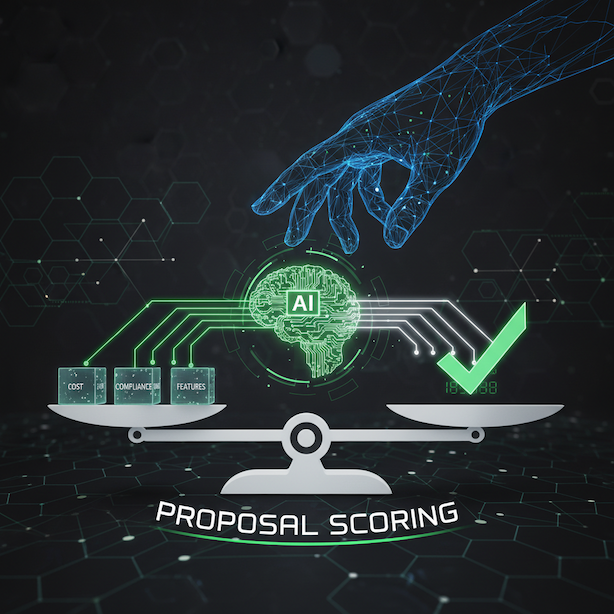
Digital Hand coming down over an AI brain to show RFP scoring with a scale

Introduction

It is the open secret of the procurement world: organizations spend tens of thousands of dollars on sophisticated, all-in-one RFP suites, yet the final, million-dollar decisions are almost invariably made in a spreadsheet. Regardless of the software purchased, the sleek dashboards, or the automated workflow notifications, the data required to actually negotiate and award a contract is exported to Excel or Google Sheets. This phenomenon, often called the "Excel inevitability," persists because decision-makers require portability, customization, and the ability to manipulate data in ways that proprietary platforms simply do not allow.

The reality is that platforms are often designed for the "process" of writing proposals, but they struggle with the "analysis" required to make a decision. When a sourcing team needs to compare five different vendors on price, compliance, and risk, they do not want to click through twenty different browser tabs. They want a side-by-side view where they can filter, sort, and apply their own formulas. However, this reliance on spreadsheets creates a massive friction point: while spreadsheets are brilliant with numbers, they are terrible at managing the dense, unstructured text found in vendor proposals.

The Critical Role of Early RFP Executive Summaries in Procurement

· 8 min read

The Critical Role of Early RFP Executive Summaries in Procurement

Introduction

In the high pressure world of procurement, teams often find themselves buried under mountains of vendor proposals. A single Request for Proposal (RFP) can result in dozens of responses, each spanning fifty or more pages.

These documents are often inconsistent in format and filled with subjective marketing language that obscures actual capabilities. Consequently, the review process becomes a messy, time consuming bottleneck that delays critical business decisions and strategic awards.

Shattering the Compliance Mirage: The Analysis-First RFP Strategy

· 8 min read

Shattering the Compliance Mirage: The Analysis-First RFP Strategy

Introduction

The journey from issuing a Request for Proposal (RFP) to selecting a vendor is often fraught with complexity and invisible risks. Many organizations treat the analysis phase as a final hurdle rather than a foundational step. This delay frequently results in a "compliance mirage" where proposals appear perfect on the surface but hide significant misalignments.

Leadership teams often feel immense pressure to shortlist candidates quickly, yet they lack a consistent method to justify these decisions. Without early, objective analysis, the process becomes a race against the clock where subjective bias and marketing language overshadow factual compliance. This often leads to friction that only surfaces after contracts are signed.

When teams rely on manual reviews and informal notes, they risk selecting vendors who excel at writing but fail at delivering. These early oversights create a ripple effect, leading to costly negotiations or failed implementations down the road.

A shift toward analysis-first strategies can help ground these critical decisions in reality.

TL;DR

  • Early Analysis is Vital: Conducting thorough analysis at the start of the review cycle can help leadership and teams align on objective facts rather than subjective impressions.
  • Identify the Compliance Mirage: Vague vendor language often masks non-compliance, a risk that specialized AI tools are designed to surface before contract problems arise.
  • Reduce Review Friction: Objective data helps eliminate internal disagreements and scoring inconsistencies that frequently stall critical procurement stages and delay vendor engagements.
  • Portable and Sharable Data: Utilizing Excel and PDF outputs allows teams to collaborate within their existing environments without the overhead of expensive third-party platforms.
  • Compress the Timeline: Moving analysis to the beginning of the process can support a 60% reduction in review cycles, helping teams reach defensible decisions faster.

The Hidden Cost of the Compliance Mirage

A common scenario in procurement involves a vendor proposal that checks every box but uses "assumptive or subjective language" to describe their capabilities. Leadership sees a sea of green compliance marks, while the actual requirements remain unaddressed beneath layers of polished marketing. These hidden gaps frequently create significant friction during the final contract negotiations or implementation phases.

Why does the RFP process feel broken?

· 7 min read

Desk full of proposals with chains and locks

Introduction

The Request for Proposal (RFP) process often feels broken because, for many, the journey has become worth more than the results. What seems like a simple activity (review documents and then make a decision) has become unnecessarily complex and slow. When the requirements or proposals are vague/obtuse, the efforts to evaluate "best fits" become a significant challenge. Some of these problems can be mitigated by ensuring requirements and expectations are well defined upfront - but that does not mean vendors will align and consistently deliver.

Why analysis-first is better than traditional RFP suites?

· 6 min read

frustrated man sitting at a desk with computer monitors worn out from reviews

Introduction

Traditional RFP suites often prioritize long-form authoring and workflow management over the critical objective of vendor evaluation. This mismatch leads to complex environments that slow down decisions and frustrate review teams who need fast answers.

Organizations frequently find that the procurement journey has become worth more than the actual result. Heavy platforms often introduce hidden costs and technical hurdles that act as barriers to efficient internal and external collaboration.

An analysis-first approach focuses on the finish line by delivering structured data at the start of the process. This shift allows leadership to base strategic decisions on objective evidence rather than subjective impressions or manual summaries.

Key Takeaways

  • Traditional suites require weeks of implementation and training before delivering any measurable value to the procurement team.
  • Analysis-first tools provide results in minutes, allowing teams to prioritize vendor engagements and compress review cycles by approximately 60%.
  • Spreadsheets remain the standard for final decisions, making portable Excel and PDF outputs more valuable than proprietary platform dashboards.
  • Consumption-based pricing models align costs with actual analysis volume, eliminating the "shelfware" problem of expensive annual seat-based licenses.
  • Automated scoring and ranking ground internal discussions in objective compliance findings, which helps to reduce bias and prevent internal disagreements.

Why Traditional RFP Suites Fail the Evaluation Phase

Many organizations struggle with "shelfware" because traditional platforms require significant time, money, and process changes to sustain. These heavy suites are often too complex for infrequent users like subject matter experts.

Traditional platforms typically force users into proprietary environments, creating security risks and duplicative content libraries. This often leads to fragmented workflows where teams eventually revert to email and spreadsheets to keep things moving.

Furthermore, these platforms focus on the "workflow layer" rather than the "analysis layer". They facilitate the creation of documents but rarely solve the bottleneck of interpreting thousands of pages of vendor text.

Generic AI tools built into these suites can summarize text, but they often struggle with criteria-based, side-by-side comparisons. They may provide narrative answers that lack the traceable justifications needed for defensible procurement.

In contrast, an analysis-first approach recognizes that the core problem is document overload and inconsistent scoring. It targets the analysis bottleneck directly, turning qualitative text into quantitative data that leadership can actually use.

Workflow Acceleration with AI

Companies need to rethink the RFP process by prioritizing analysis and decisions over lengthy platform implementation journeys. Shifting analysis to the start of the process helps focus review teams on high-priority engagements.

An AI tool like BidHawk AI transforms this model by delivering executive summaries and scoring in less than five minutes. It eliminates the need for manual alignment of vendor data, which typically consumes weeks.

This analysis-first tool uses a simple drag-and-drop interface that requires no technical training or IT integration. Users can upload requirements and proposals to receive immediate rankings against their specific criteria.

The tool identifies compliance gaps by tagging responses as compliant, subjective, or non-compliant. This objective "Digital SME" lens ensures that every vendor is evaluated against the same standards without human bias.

Results are delivered in familiar PDF and Excel formats, allowing teams to collaborate within their existing office environments. This portability ensures that high-quality data is available for selection write-ups and vendor feedback.

By using this method, teams can identify their top vendor candidates in days rather than weeks. This 60% reduction in review time allows organizations to move from a stack of documents to a defensible shortlist faster.

Frequently Asked Questions (FAQ)

Why not just keep using spreadsheets for the entire review process?

BidHawk AI: Faster RFP Compliance Matrix Generation

· 9 min read

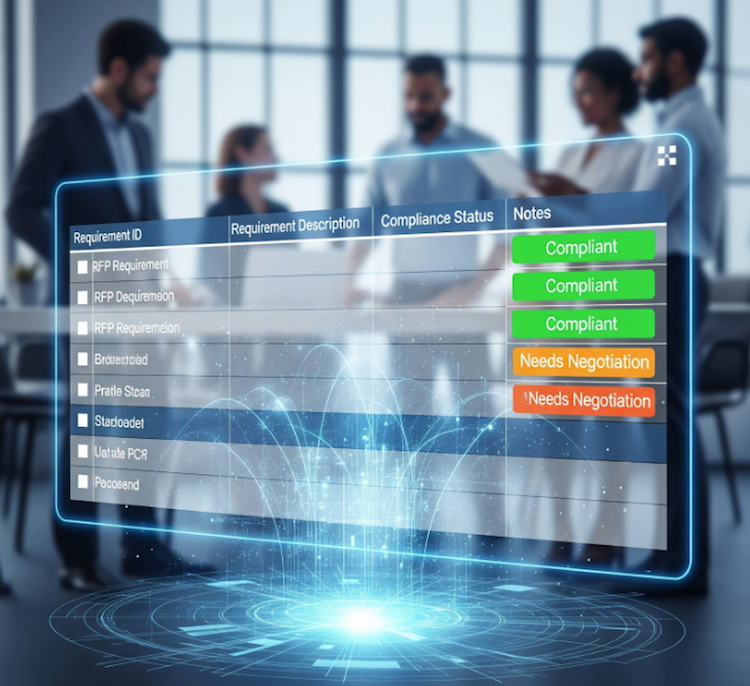
Image of a computer screen showing vendor proposal scores with people behind it

AI for Automating RFP compliance matrices.

You have reached the final deadline for your latest Request for Proposal (RFP). The submissions are in, but now you face 20 different vendor proposals, totaling hundreds of pages of dense technical and legal jargon.

The initial relief of receiving bids often turns into the dread of the "messy middle." This phase usually requires weeks of manual reviews to identify which vendor is actually compliant with your requirements.

BidHawk AI: Accelerating Reviews and Decisions

· 8 min read

cartoon of a man peeking out from under a pile of proposals

AI for Accelerating Proposal Reviews and Decisions

Introduction

You have finally reached the deadline for your Request for Proposal (RFP). You spent weeks herding internal cats to get the requirements right, you fought for the budget, and you finally hit send. The submissions are in, and for a brief moment, you feel relief. Then, you open your inbox and stare at the reality: 20 different vendor proposals, all formatted differently, totaling hundreds of pages of dense technical and legal jargon.

The initial relief of receiving bids instantly curdles into the dread of the "messy middle": the weeks of manual reviews required to identify the best options. This is where the real pain begins. You are facing 20 to 80 hours of what industry experts call "spreadsheet archaeology"-digging through PDFs to find answers, manually typing them into Excel, and trying to remember if Vendor A’s security protocol was actually compliant or just sounded nice.

The question every procurement leader and business development manager asks is: "What AI tools can accelerate proposal reviews?" Traditionally, the answer was either "hire more people" or "buy expensive software" that requires months of implementation. However, a new generation of specialized AI analysis tools is changing this dynamic. By automating the heavy lifting of scoring and ranking, these tools help teams cut review cycles by approximately 60%, transforming weeks of reading into minutes that inform strategic decision-making.

TL;DR: Key Takeaways

  • The "Friday Afternoon" Effect: Manual reviews suffer from reviewer fatigue; a proposal read on Friday afternoon rarely gets the same attention as one read on Tuesday morning, leading to inconsistent scoring.
  • Analysis Over Administration: The goal is not just to read proposals but to score, rank, and identify gaps to inform critical decisions quickly.
  • Automated Ranking: AI analysis tools like BidHawk AI act as a consistent "Digital Subject Matter Expert," automating the scoring and compliance checking process to provide an objective baseline.
  • Results in Minutes: Specialized tools can analyze documents in less than 5 minutes, allowing teams to start decision-making on Day 1 rather than waiting for software implementation and data to be aligned.
  • Focus on Exceptions: By tagging compliance items as "Compliant," "Needs Negotiation," or "Subjective," teams can skip the boilerplate approaches and focus 100% of their energy on high-risk areas immediately vs getting lost in the sea of text.

The Challenge: Why Manual Reviews Are Too Slow

To understand how AI accelerates the process, we must first look at what slows it down. The friction in proposal reviews usually stems from three specific structural disadvantages that drain the passion out of even the most dedicated procurement teams.

The "Needle in the Haystack" Problem

When a team receives 10 to 30 proposals per RFP, the sheer volume of documentation becomes unmanageable. Reviewers often spend 20 to 80 hours just reading and mapping responses to requirements (assuming the requirements and measures for success were clear to begin with). As fatigue sets in, the quality of the reviews drop. This leads to missed requirements and inconsistent scoring simply because the human brain struggles to maintain peak attention across hundreds of pages of technical text.

The "Subjectivity Trap"

Even with a clear rubric, two humans will often interpret the same answer differently. One might see a vendor's "partial" answer as a deal-breaker, while another sees it as acceptable. This inconsistency makes it incredibly difficult to create a defensible shortlist. Teams often end up spending more time de-conflicting their own "scoring wars" than analyzing the actual value of the vendors.

"Spreadsheet Hell"

Most teams rely on Excel for comparisons. However, manually typing proposal data into spreadsheets is slow and error-prone. It creates a "data prison" where context is lost, and version control becomes a nightmare as spreadsheets are emailed back and forth between stakeholders.

How AI Analysis Tools Such as BidHawk AI Can Help

The fastest way to cut through this noise is to employ an AI tool designed specifically to solve the "analysis gap." BidHawk AI addresses these bottlenecks by focusing on the analysis layer, acting as a lightweight utility that allows users to drag-and-drop requirement documents and proposals to get immediate insights. Don’t worry, you can still use spreadsheets!

Automated Scoring and Ranking

Instead of manual data entry, BidHawk AI automatically reviews, analyzes, and ranks proposal submissions against your RFI, RFP, or RFQ requirements. It acts as a neutral "Digital Subject Matter Expert" (SME), applying consistent evaluation logic to every document. This helps buyers quickly identify the best-aligned candidates and prioritize their efforts on the most promising vendors without the bias inherent in manual reviews.

Gap Identification and Risk Tagging

Speed often comes at the cost of accuracy, but specialized AI avoids this trade-off. BidHawk AI categorizes specific findings into four actionable buckets:

  • Compliant
  • Needs Negotiation
  • Subjective
  • Non-Compliant

This granularity allows review teams to ignore the clear-cut "Compliant" sections and focus their energy on the "Subjective" or "Needs Negotiation" items where the real risks lie. It explicitly flags where a vendor failed to address a requirement or used "marketing fluff" instead of facts, ensuring no gap goes unseen.

Speed Metrics: 5 Minutes to Insight

One of the most significant advantages of modern AI analysis tools is the "time-to-value." While traditional platforms often require weeks of configuration and content library population, BidHawk AI is designed to deliver analysis results typically in less than five (5) minutes. This efficiency allows teams to move from a stack of unread documents to a ranked list almost immediately, potentially reducing the overall review and decision process by 60%.

Downloadable Reports for Collaboration

Recognizing that most final decisions happen in spreadsheets, BidHawk AI does not trap data in a dashboard. It exports structured analysis to PDF Executive Summaries and Excel data files.

  • For Leadership: They get a high-level summary with cited justifications regarding Cost, Benefits, Risks, and Schedule to approve next steps quickly.
  • For Teams: They get detailed Excel comparisons to verify compliance and collaborate within their existing environments (like Google Workspace or Office 365) without paying for extra software seats.

BidHawk AI: Better RFP Analysis Than ChatGPT

· 7 min read

Woman sitting at desk looking at a computer screen

Beyond ChatGPT: Why You Need Specialized AI for RFP Analysis

The temptation is understandable. You have a subscription to a consumer AI model like ChatGPT, Gemini, or Claude. You have a stack of 50-page vendor proposals. Why not just paste the text into the chat window and ask, "Which vendor is better?" Seems simple right?! But there is more to consider.

The "DIY" approach to procurement analysis is growing, driven by the desire for speed and the frustration with expensive legacy RFP platforms and software. However, while general-purpose AI is excellent for summarizing emails or drafting text, it often fails when tasked with the high-stakes, structured analysis required in procurement.