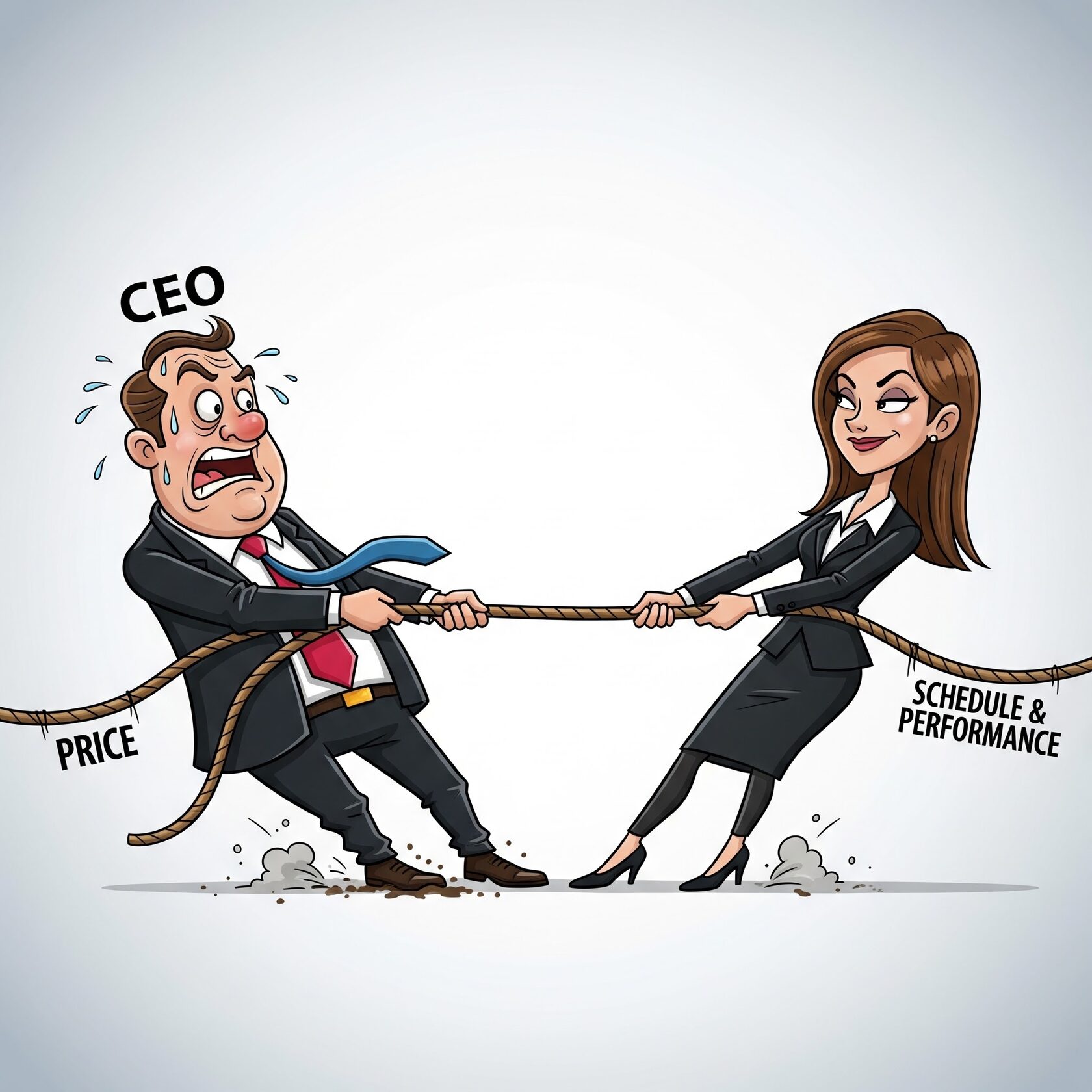
Cost Attracts, but Schedule and Performance are MORE important.
Introduction
In the high stakes world of procurement, the temptation to over promise is a constant threat. Companies often get blinded by the allure of attractive costs, leaving the reality of schedule and performance as an afterthought.
Cost, Schedule, and Performance are strongly related elements that dictate the success or failure of any engagement. Cost acts as the practical attractor, but schedule represents the undeniable reality of execution.
Ultimately, performance confirms both cost and schedule through actual execution and deliverables. When review teams fail to evaluate schedules with proper skepticism, the risks of project failure increase significantly.
TL;DR
- Cost, Schedule, and Performance must be consistently evaluated together by procurement teams to successfully avoid over promising and ultimately failing to deliver on critical project expectations.
- While cost often serves as the initial attractor for leadership, the proposed schedule dictates the realistic and necessary sequence of events required for overall project success.
- Performance confirms whether the proposed cost and schedule can actually yield the expected deliverables, requiring teams to scrutinize vendor claims with a high degree of skepticism.
- Evaluating complex proposals demands objective data to uncover hidden risks, highlight compliance gaps, and expose subjective marketing claims that often obscure the true realities of execution.
- AI analysis tools like BidHawk AI can help structure complex vendor data into clear executive summaries, accelerating review cycles and grounding strategic decisions in factual evidence.
The Danger of Ignoring Schedule for Cost
Many organizations fall into the trap of prioritizing cost above all else when evaluating vendor proposals. This singular focus often obscures the critical details embedded within the proposed schedule and performance milestones.
A schedule is often presented as speculative during the proposal phase, but the time and sequence of events are critical to performance. If a vendor cannot logically explain their work sequence, the price becomes meaningless.
Review teams frequently struggle to dissect these interconnected elements. Vendor proposals are often packed with vague terminology and subjective marketing language. Teams spend weeks grinding through hundreds of pages trying to find factual alignments.
Spreadsheets are ubiquitous and convenient for organizing numbers, but they fundamentally fail at contextualizing long form text. Forcing paragraphs of performance specifications into isolated spreadsheet cells destroys the context needed to make informed decisions.
Without structured data and objective analysis, leadership must make strategic decisions based on inconsistent scoring and subjective reviewer opinions. This creates a dangerous gap between what is promised during procurement and what is actually delivered.
Grounding Evaluations with AI Analysis
To avoid the pitfalls of over-promising, companies need a way to objectively extract and analyze cost, schedule, and performance data early in the review process. A specialized AI analysis tool can dramatically shift the paradigm.
BidHawk AI is designed to act as your Digital Subject Matter Expert. It can help to automatically review and score proposals against your specific requirements. Users simply drag and drop files and press a button to begin.
BidHawk AI generates executive summaries that clearly articulate the costs, benefits, risks, and schedule impacts for each proposal. These summaries help leadership understand fit and trade-offs quickly, prioritizing strategic engagements based on factual evidence.
The tool performs document level comparative analysis and typically delivers results in less than 5 minutes. By identifying compliance gaps upfront, BidHawk AI can help review and decision processes be completed 60% faster.
Furthermore, BidHawk AI provides downloadable reports in PDF and Excel formats. This allows teams to seamlessly share findings and collaborate within their existing office environments, avoiding the heavy overheads associated with traditional RFP suites.
Frequently Asked Questions (FAQ)
What are the primary reasons why evaluation teams frequently struggle to assess vendor schedule and performance accurately during complex procurement reviews?
Vendor proposals often bury critical schedule assumptions deep within subjective marketing narratives. Reviewers using manual processes find it incredibly difficult to cross-reference these scattered details against original requirements without losing context.
How does an AI analysis tool differ fundamentally from traditional RFP suites when it comes to evaluating vendor proposals and requirements?
Traditional RFP suites are heavily focused on document authoring and workflow management. BidHawk AI focuses purely on the analysis layer, providing a low cost tool that requires no long term contracts or process overhauls.
Can an AI analysis tool like BidHawk AI effectively help review teams identify over promised capabilities and hidden vendor compliance risks?
Yes, BidHawk AI is designed to flag vague vocabulary and identify responses that are Compliant, Needs Negotiation, Subjective, or Non-Compliant. This helps teams focus their skepticism on areas that lack concrete evidence.
How do automated executive summaries improve the overall procurement process and assist leadership in making faster, more informed strategic decisions?
Executive summaries distill complex proposals into clear overviews of cost, benefits, risks, and schedule. This helps leadership prioritize their reviews and grounds initial discussions in objective data rather than inconsistent reviewer opinions.
Is it truly safe and reliable to use AI technology for evaluating highly sensitive vendor proposals during critical procurement decisions?
While generic chatbots present data privacy and consistency concerns, a specialized AI analysis tool like BidHawk AI provides traceable justifications. This ensures that evaluations are transparent, consistent, and ready for strict organizational audit.
Conclusion
The journey from an initial proposal to a successful project delivery is fraught with risks. Evaluating the intricate relationships between cost, schedule, and performance is a complex but necessary task for any procurement team.
Relying solely on manual spreadsheet reviews and subjective interpretations often leads to delayed decisions. Organizations cannot afford to let the evaluation process become more cumbersome and expensive than the actual project outcomes.
By integrating an AI analysis tool like BidHawk AI into the workflow, teams can transform unstructured text into actionable data. This approach empowers leadership to approach every evaluation with healthy skepticism and clear justifications.
Ultimately, achieving a realistic balance of cost, schedule, and performance requires objective analysis. Embracing specialized tools can help ensure your next vendor selection is grounded in reality, setting the stage for successful execution.
Related Articles
Why analysis-first is better than traditional RFP
suites?
BidHawk AI: Automated Proposal
Scoring
BidHawk AI: Proposal Evaluation Beyond
Excel
BidHawk AI: Justifying Vendor
Selections
Shattering the Compliance Mirage: The Analysis-First RFP
Strategy
BidHawk AI: Reduce Bid Evaluation
Time