Procurement Enshittification: How AI is affecting Buyers and Sellers
Introduction
If you've tried to hire anyone in the past year, you've seen this movie before. Hiring managers are drowning in perfect-looking resumes - LinkedIn processes 11,000 applications every minute. Every candidate has the right keywords. Every cover letter sounds professional. But finding the right person has never been harder because when everyone looks perfect, you can't tell anyone apart.
Now procurement is living through the exact same crisis.
You send out an RFP and receive 40 vendor proposals instead of the usual 10 - all perfectly formatted, professionally written, totaling hundreds of pages. Everything looks impressive. But when you start reading, you realize something troubling: you can't tell anyone apart.
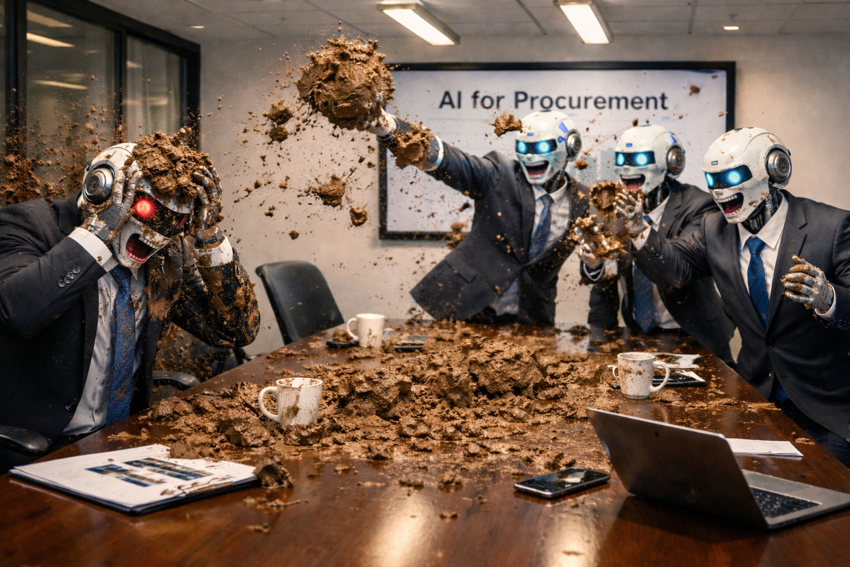
AI is accelerating “Procurement Enshittification".
“Enshittification” was a term coined by tech critic Cory Doctorow to describe how platforms that promise to make life easier end up making everything worse. The American Dialect Society named it their 2023 Word of the Year.
The problem is two-sided and fueled by AI misuse. Vendors use AI drafting tools to flood buyers with lengthy responses that sound good but lack specificity. Buyers use AI to generate requirements from outdated content libraries that pull claims from past projects without understanding current context. The result is a massive explosion of text - a "compliance mirage" where proposals look perfect but hide significant gaps.
Instead of streamlining the process, AI has created a "messy middle" where human reviewers are drowning in content. To survive this flood, procurement leaders must shift their focus from generating documents to analyzing them.
TL;DR: Key Takeaways
The Content Catalog Trap: RFP platforms rely on content libraries requiring 200+ hours to build and constant maintenance. Worse, they pull content without understanding context - past claims get autocompleted into situations where they don't apply.
The Volume Explosion: AI response tools dropped vendor barriers from 20-28 hours per RFP to under an hour. You're going from 10 thoughtful proposals to 30-50 AI-generated submissions.
The "Friday Afternoon" Effect: Manual review teams can't maintain focus across hundreds, or even thousands, of pages. Proposals read late get less attention, leading to inconsistent scoring and missed gaps.
The Evaluation Bottleneck: The problem isn't creating RFPs or vendors responding - it's evaluation. Platforms optimize document generation while making the hard part exponentially harder.
The BidHawk AI Solution: Purpose-built evaluation tools automatically score proposals against your specific criteria in minutes. No content library to maintain. No chatting with documents. Just clear analysis of who meets requirements.
The Two-Sided Trap: Why More AI Equals More Work
The friction in modern procurement stems from a structural imbalance:
- The ease of creating content has vastly outpaced the ability to evaluate it.
This creates a perfect storm where both sides think they're being efficient while actually making everything worse.
The Vendor Side: Context-Free Autocomplete
Vendors use response automation platforms that generate answers from content libraries. The AI sees "security requirements" in your RFP and pulls and folds in language: "We successfully produced a secure product meeting HIPAA requirements for a major healthcare client."
What the AI doesn't know is that the previous project was a simple web portal while your need is a complex data platform. It doesn't understand that the client had their own security team doing half the work. The AI just pattern matches:
- security query → retrieve security content → sounds good → insert.
This is glorified autocomplete with dangerous confidence. Just because they said something once doesn't mean it's true for your situation. But it looks professional, so nobody questions it until six months into a failed project.
AI makes very convincing statements based on limited contextual assumptions or previous examples that can be easily interpreted as “yea, that sounds right” by the reader (buyer or seller). When marketing of (plausible) compliance is not able to be supported by clear evidence - risks go up!
The Buyer Side: The "Needle in the Haystack"
When you receive 30-50 proposals instead of the usual 10, the volume becomes unmanageable. Your team spends 20-80 hours per project in "spreadsheet archaeology" - digging through PDFs and manually typing into Excel to build out a compliance matrix. As fatigue sets in, evaluation quality drops. Critical gaps get missed because the human brain cannot maintain peak attention across hundreds of pages.
The irony is brutal: AI was supposed to reduce this workload, but it's actually increasing it. Vendors can now submit proposals with minimal effort, so everyone responds. But your evaluation capacity hasn't changed - especially when 41% of companies experienced failed supplier partnerships in the past year due to inadequate vetting.
The "Subjectivity Trap"
When proposals are full of vague, marketing-heavy language - "industry-leading security," "comprehensive compliance," "world-class support" - two reviewers will interpret the same answer completely differently. Teams spend more time resolving their own "scoring wars" than analyzing actual vendor value. This is not strategic work, this is subjective work.
This is where "lazy acceptance of words from other documents" becomes dangerous. AI-generated proposals sound professional and confident, so reviewers assume the vendor knows what they're talking about. But professional-sounding doesn't mean accurate, and by the time you discover the misalignment, you're already committed.
The Content Catalog Illusion: Why Platforms Make It Worse
At the heart of most RFP platforms sits a content catalog - a library promising to capture ALL your institutional knowledge. The pitch is compelling: build it once, use it forever, let AI handle the rest.
The reality is far more dangerous. Building a comprehensive catalog requires 200+ hours upfront, then needs constant maintenance as technology evolves and regulations change. Someone's job becomes keeping that catalog current forever. There is no easy button here.
But maintenance is only part of the problem. The real danger is contextual misapplication. Your catalog contains a statement from a past project: "We produced a secure product meeting HIPAA requirements." Now a new RFP mentions security, and your AI pulls that language. It looks relevant. Nobody questions it.
But that previous project was different - different scope, different resources, different requirements. In these situations, AI doesn't understand context and applicability. It just sees matching keywords and often inserts content with complete confidence due to predictive relevance not fact (afterall humans are going to read it - right?). This can result in requirements that sound sophisticated but actually ask for the wrong things (expensive or in complete). Vendors can end up writing proposals claiming capabilities they don't actually have for this specific need or situation.
This creates what we call a "compliance mirage" - everything looks perfect on paper because the documents are polished and professional, but underneath lies a fundamental misalignment that won't become obvious until it's far too late to fix.
How Purpose-Built Analysis Tools Cut Through the Noise
The solution to "Procurement Enshittification" isn't to hire more reviewers or build bigger content libraries.
It's to employ AI specifically designed to solve the evaluation bottleneck - tools that focus entirely on analysis rather than document generation.
It should be noted that “shitty” requirements in an RFP will work against the entire process for buyers and sellers.
If you want to make a genuine mess of things fast - be as vague as possible and assume everyone knows what you mean when writing your RFP requirements and evaluation criteria for vendors to submit against.
AI can help draft and author these documents; BUT, human subject matter experts (SMEs) MUST confirm every requirement and measure of success before publication to get the best results (and this is situation specific - never treat IT purchases like bolts and screws).
Automated Scoring Against Your Specific Criteria
Instead of chatting with documents asking "What did Vendor A say about security?", you define your requirements once with specificity: "SOC 2 Type II certification required, evidence of annual penetration testing, incident response plan with defined SLAs." Then the AI evaluates all vendors against this criterion simultaneously, showing who met requirements with evidence, who didn't, and what's missing.
Tools like BidHawk AI act as a neutral "Digital Subject Matter Expert (SME)," applying consistent evaluation logic to every document. This eliminates the "Friday afternoon effect" where the last proposal gets less attention than the first.
Cutting Through the "Fluff" to Focus on Risk
Purpose-built tools categorize findings into actionable buckets: Compliant, Needs Negotiation, Subjective, and Non-Compliant. BidHawk AI automatically does this, enabling review teams to quickly understand clear-cut "Compliant" sections and focus 100% of their expertise on "Subjective" or "Needs Negotiation" or “Non-Compliant” vendor items where real risks lie.
Speed Metrics: Minutes to Insight, Not Weeks to Excel
With BidHawk AI, you simply upload your RFP with explicit criteria and all proposals. Get ranked results showing which vendors meet requirements with evidence and which have critical gaps. Your team focuses on detailed reviews of qualified candidates with comparative analysis and risk flags.
Time savings: 50 vendors × 28 hours = 1,400 hours manual versus 4 hours AI screening + 120 hours focused review = 124 hours total. That's 91% reduction while improving consistency. Results export cleanly to Excel, PowerPoint, and Word - flowing into where your work actually happens.
Frequently Asked Questions
Does AI replace human reviewers? No. BidHawk AI handles sorting, ranking, and compliance checking so human experts can focus on strategy, negotiation, and final selection.
Is this faster than manual spreadsheet work? Yes. Manual data entry, or copy/paste and reference, is error-prone and slow. Purpose-built analysis provides results in minutes while delivering the Excel outputs teams need.
Do I need to migrate data or build content libraries? No. BidHawk AI is an analysis tool, not a document repository. Drag and drop files, get results, move on. No library to maintain. No context-free autocomplete from past projects.
How does this help if vendors are using AI to write proposals? It levels the playing field. Purpose-built tools cut through generic language by identifying specific compliance gaps and tagging subjective claims, ensuring you judge vendors on facts rather than AI writing quality.
Actionable Takeaways
The hiring industry just learned this lesson the hard way. Applications exploded by 200%, trust collapsed, and despite having more "perfect" candidates than ever, finding the right person became nearly impossible. Procurement has the chance to avoid this fate - but only by being honest about where AI helps versus where it hurts.
Stop Manual Entry: Don't waste time identifying and typing proposal data into spreadsheets. Use analysis tools like BidHawk AI to automate extraction and scoring.
Focus on Exceptions: BidHawk AI automates compliance tagging so you can focus on "Subjective", “Needs Negotiation”, and "Non-Compliant" vendor items rather than reviewing clearly compliant sections. This data helps focus teams on the important stuff and get to consensus sooner, and helps document justifications for “why” decisions were made.
Avoid the Content Library Trap: Don't spend 200+ hours building catalogs that require constant maintenance and create context-free autocomplete problems.
Demand Data Portability: Stick to your in-house tools for drafting, storage, and collaboration. Use specialized analysis tools that export results to Excel, PowerPoint, and Word.
Start With What You Have: Purpose-built tools require no setup, integration, or care and feeding. Run a pilot on your current RFP immediately with BidHawk AI - the results delivered in a familiar and easy to use format that you can load and collaborate in our own environments.
Choose Focused Over Comprehensive: The tools that work solve specific problems exceptionally well. They handle evaluation - the actual bottleneck - and get out of your way.
By leveraging purpose-built AI analysis tools like BidHawk AI, you transform a weeks-long administrative burden into a strategic, data-driven decision process that takes minutes. The best procurement practices are shifting from the long journey to a decision to analysis up front!
The enshittification of procurement is here! Choose tools that fight it, not feed it.
Reference Articles
- Resume Genius - "AI's Impact on Hiring in 2025" - https://resumegenius.com/blog/job-hunting/ai-impact-on-hiring
- LinkedIn - "The Future of Recruiting 2025" - https://business.linkedin.com/talent-solutions/resources/future-of-recruiting
- Deloitte - "2025 Global Chief Procurement Officer Survey" - https://www.deloitte.com/us/en/services/consulting/articles/2025-global-chief-procurement-officer-survey.html
- American Dialect Society - "2023 Word of the Year Is 'Enshittification'" - https://americandialect.org/2023-word-of-the-year-is-enshittification/
Additional Reading
Shattering the Compliance Mirage: The Analysis-First RFP
Strategy
Why does the RFP process feel
broken?
Why analysis-first is better than traditional RFP
suites?
BidHawk AI: Faster RFP Compliance Matrix
Generation
BidHawk AI: Automated Proposal
Scoring
AI-Enabled Proposal Writing/Reviewing
Platforms